
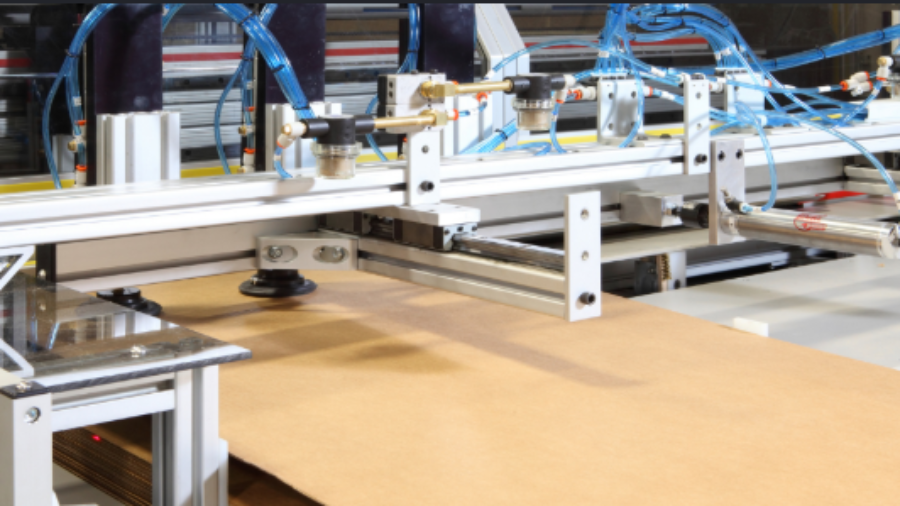
Automatic Cardboard Cutting Machines: Precision, Waste Reduction and PLC Automation
In the cardboard packaging and corrugated board manufacturing industries, cutting accuracy directly affects product quality, material consumption, production efficiency and downstream packaging operations.
Even small dimensional deviations can lead to rejected products, excessive material waste and unexpected production downtime, especially in high-speed manufacturing environments.
Automatic cardboard cutting machine automation combines programmable logic controllers (PLCs), servo drives, encoders and industrial sensors to coordinate material feeding, positioning, measurement and cutting operations.
Based in Denizli, Turkey, Duos Automation provides industrial automation engineering solutions for cardboard and corrugated board processing equipment, including PLC programming, servo motion control, electrical system integration and machinery modernization.
What Causes Cutting Accuracy Problems in Cardboard Cutting Machines?
Dimensional inaccuracies in cardboard cutting operations are not always caused by cutting blades or mechanical components.
In many applications, the primary challenge is maintaining synchronization between the material feeding mechanism and the cutting system.
In continuous production environments, material feeding speed, encoder feedback and cutting cycle timing must operate in coordination.
Common causes of inaccurate cardboard cutting include:
- Material slippage between feeding rollers
- Encoder calibration errors or incorrect measurement settings
- Servo motor positioning inaccuracies
- Poor synchronization between cutting mechanisms and production speed
- Incorrect machine settings for different board thicknesses
- Sensor delays or inaccurate product detection
- Mechanical backlash and component wear
- Inconsistent material feeding and tension
Addressing these issues may require a combination of mechanical inspection, control system optimization and motion control improvements.
Simply replacing cutting blades or individual machine components may not resolve the underlying problem.
How Do Servo-Controlled Cardboard Cutting Machines Work?
Servo-controlled cardboard cutting machines use programmable motion systems to coordinate feeding and cutting operations.
Depending on the machine configuration, an encoder measures material movement while the PLC or motion controller calculates the required cutting position.
The cutting mechanism is then activated according to programmed length, position and timing parameters.
Servo-driven systems can support:
- Precise cardboard sheet feeding
- Automatic cutting length adjustment
- Cutting blade positioning
- Synchronization of rotary cutting mechanisms
- Coordination of cutting and creasing operations
- Automatic adjustment for different product dimensions
Programmable motion profiles allow manufacturers to adapt cutting operations to different production requirements.
However, cutting precision depends on more than servo motor performance.
Mechanical rigidity, encoder resolution, feeding accuracy, material characteristics and control algorithms all influence the final cutting result.
Automatic Cardboard Size Adjustment for Flexible Production
Packaging manufacturers frequently process cardboard and corrugated board products in different sizes on the same production line.
Manual machine adjustments can increase changeover times, require repeated operator intervention and introduce positioning inconsistencies.
Automatic cardboard size adjustment systems allow operators to select product dimensions through a Human-Machine Interface (HMI).
On machines equipped with suitable motorized adjustment mechanisms, the automation system can manage:
- Cardboard sheet length and width
- Cutting start and end positions
- Blade positioning
- Creasing line positions
- Material feeding speed
- Cutting cycle parameters
- Production quantities and batch settings
Frequently used product configurations can be saved as machine recipes.
When switching between product sizes, operators can select the appropriate recipe rather than manually entering every parameter.
This capability is particularly valuable for packaging manufacturers handling multiple product formats and frequent production changeovers.
How Can Automation Reduce Waste in Corrugated Board Cutting?
Material waste is a significant cost factor in cardboard and corrugated packaging manufacturing.
Incorrect cutting lengths, feeding inconsistencies and production setup errors can increase scrap rates and reduce overall production efficiency.
Reducing waste requires careful evaluation of both mechanical systems and industrial automation controls.
Accurate Length Measurement
Encoders and feedback systems allow the machine to monitor material movement and calculate cutting positions.
Correct calibration and reliable material feeding are essential for maintaining measurement accuracy.
Print Registration Control
For printed cardboard and packaging materials, optical sensors can detect registration marks and help synchronize the cutting position with the printed design.
This is especially important when cuts must align with graphics or predefined product features.
Controlled Acceleration and Deceleration
Servo motor motion profiles provide controlled speed changes during feeding and cutting operations.
Properly configured acceleration and deceleration parameters can reduce unnecessary mechanical stress and improve motion stability.
Automatic Rejection of Defective Products
When suitable inspection and detection equipment is installed, products identified as defective can be directed toward a rejection mechanism.
Production Data Monitoring
Monitoring rejected products, cutting errors, downtime and production counts helps manufacturers identify recurring problems and evaluate process improvements.
Reducing material waste in cardboard cutting requires a coordinated approach involving machine mechanics, automation software, motion control and production monitoring.
PLC-Controlled Cardboard Cutting Machines and Production Monitoring
PLC automation does more than control motors, sensors and cutting mechanisms.
Modern control systems can also provide operators and production managers with important information about machine performance.
Through an HMI control panel, manufacturers can monitor:
- Current production speed
- Total number of cardboard sheets processed
- Target production quantities
- Active machine recipes
- Operating and downtime status
- Sensor and drive alarms
- Cutting error notifications
- Machine fault history
When appropriate communication infrastructure is available, production data can be transferred to SCADA or centralized manufacturing monitoring systems.
This allows manufacturers to evaluate cardboard cutting machine performance as part of the overall production process.
Cardboard Cutting Machine Retrofitting and Modernization
Many cardboard and corrugated board cutting machines remain mechanically operational long after their original electrical control systems become outdated.
Older machines may experience difficulties related to obsolete PLC hardware, unsupported drives, limited operator interfaces and replacement component availability.
In these situations, cardboard cutting machine retrofitting can provide an alternative to purchasing entirely new equipment.
Modernization projects may include:
- Replacing obsolete PLC control systems
- Redeveloping machine control software
- Upgrading servo motors and drives
- Installing new encoders and measurement sensors
- Integrating modern touchscreen HMI panels
- Adding automatic product recipe management
- Improving feeding and cutting synchronization
- Refurbishing electrical control cabinets
- Upgrading machine safety controls
- Implementing production monitoring and fault diagnostics
Before beginning a retrofit project, engineers should evaluate the machine’s mechanical condition, cutting technology, motor configuration and existing electrical architecture.
Duos Automation’s cardboard cutting system automation solutions can be considered for new machine control projects and the modernization of existing industrial equipment.
Integrating Cardboard Cutting, Carton Folding and Packaging Lines
In many manufacturing facilities, cardboard cutting is only one stage of the complete packaging production process.
After cutting, cardboard sheets may require folding, creasing, gluing, product loading or stacking.
When machines operate independently, differences in production speed can create bottlenecks and material accumulation between workstations.
Integrated automation systems enable machines to exchange operating signals and coordinate material flow.
For example, a cardboard cutting machine can communicate with downstream carton folding automation systems to synchronize production sequences.
Further integration with packaging automation systems and palletizing systems can support a more coordinated production environment.
This approach helps manufacturers move from isolated machine automation toward integrated production line control.
How to Choose the Right Automation System for a Cardboard Cutting Machine
Selecting an appropriate automation architecture requires more than choosing a PLC brand or servo motor power rating.
The correct solution depends on production requirements, machine design and the intended cutting process.
Before developing an automation project, manufacturers should consider the following questions:
- Is the material solid cardboard, paperboard or corrugated board?
- Is the material supplied as individual sheets or from a continuous roll?
- Does the machine use rotary cutting, guillotine cutting or die cutting?
- What production speed and cutting tolerance are required?
- How many different product dimensions will the machine process?
- Is print registration or vision-based positioning required?
- Will the machine be integrated into an existing production line?
- Is the existing mechanical structure suitable for modernization?
These factors help determine the appropriate PLC, servo drives, encoders, sensors and operator interface configuration.
A well-planned automation system should match the machine’s mechanical capabilities and support its intended operating conditions.
Cardboard Cutting Machine Automation Engineering – Duos Automation Turkey
Established in 2018 in Denizli, Turkey, Duos Automation specializes in industrial automation, PLC programming, electrical engineering, motion control and machinery modernization.
The company develops control and integration solutions for industrial machinery manufacturers and production facilities.
For cardboard cutting automation projects, engineering activities may include machine assessment, control architecture development, PLC software programming, servo drive integration and electrical system commissioning.
Duos Automation can evaluate project-specific control requirements for manufacturers developing new cardboard cutting machines or upgrading existing equipment.
Looking for PLC programming, servo motion control or cardboard cutting machine retrofit solutions?
Contact Duos Automation to discuss your machine specifications and industrial automation requirements.
Frequently Asked Questions About Cardboard Cutting Automation
How does an automatic cardboard cutting machine work?
An automatic cardboard cutting machine feeds material through a mechanical system and cuts it according to predefined dimensions. PLCs, encoders, sensors and servo drives can coordinate material feeding and cutting operations.
What are the advantages of servo-controlled cardboard cutting machines?
Servo control provides programmable positioning, repeatable movement and controlled acceleration. These features are particularly useful for machines processing different cardboard sizes and production formats.
How can cutting accuracy be improved in corrugated board machines?
Cutting accuracy can be improved through encoder calibration, stable material feeding, optimized motion control, correct cutting synchronization and maintenance of mechanical components.
Can a corrugated board cutting machine be controlled by a PLC?
Yes. With appropriate electrical equipment and control software, a PLC can manage feeding, measurement, cutting, product counting and machine diagnostics.
Can older cardboard cutting machines be retrofitted?
Yes. Depending on their mechanical condition and technical compatibility, older machines can be upgraded with modern PLCs, HMIs, servo drives, encoders and industrial sensors.
What is automatic cardboard size adjustment?
Automatic cardboard size adjustment uses programmable controls and suitable motorized mechanisms to position machine components according to selected product dimensions.
Can automation reduce cardboard cutting waste?
Properly designed automation systems can help reduce cutting errors and material losses caused by inaccurate positioning or synchronization. Actual results depend on machine condition, material characteristics and process requirements.
Does Duos Automation provide cardboard cutting machine automation services?
Duos Automation is based in Denizli, Turkey, and provides industrial automation engineering services, including PLC programming, servo motion control, electrical integration and machinery modernization.