
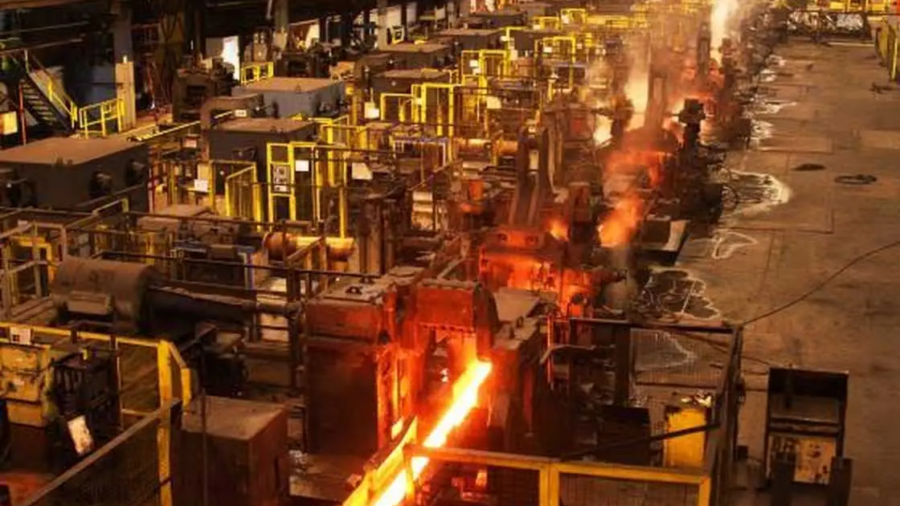
Rolling Mill Automation: Automation Systems and Services for Rolling Mills
In iron and steel production, high production speed, process continuity, and product quality depend largely on the precise control of the production line. Rolling mill automation is an automation infrastructure that ensures the synchronized operation of motors, drives, sensors, shears, conveyors, and other production equipment within a rolling mill.
In a modern rolling mill, the mere operation of machinery is not enough. It is essential to accurately manage line speed, ensure motors operate in harmony, continuously monitor process parameters, rapidly detect potential faults, and record production data.
With its engineering team based in Denizli, DUOS Otomasyon develops solutions for iron and steel plants, including new rolling mill automation systems, the revamping of existing systems, PLC software, HMI and SCADA systems, drive applications, and production line modernization.
What Is Rolling Mill Automation?
Rolling mill automation refers to the set of systems that enable the automatic control of machinery used in hot or cold rolling processes, in accordance with established production parameters.
Data received from sensors along the production line—such as:
- speed,
- position,
- temperature,
- torque,
- current,
- tension,
- pressure,
- thickness,
- length
—is processed and evaluated by PLCs and other control equipment. Based on the data obtained, the control system sends the necessary commands to motors, frequency inverters, servo systems, shears, conveyors, and other field equipment.
In this way, different sections of the rolling mill line can operate in a coordinated manner as parts of a single production process.
Why Is Rolling Mill Automation Important?
Rolling mill facilities are complex plants where high-power motors and high-speed production equipment operate together.
A speed or synchronization issue at any point along the line can affect other parts of the production process.
A well-designed rolling mill automation system helps to:
- ensure the controlled operation of the production line,
- achieve line synchronization,
- maintain more consistent product quality,
- reduce downtime,
- monitor process parameters,
- track energy consumption,
- minimize the need for operator intervention,
- record production data.
DUOS Rolling Mill Automation Services
DUOS Otomasyon can develop various automation solutions tailored to the process structure and existing infrastructure of a rolling mill facility.
1. PLC Programming and Control Systems
The PLC (Programmable Logic Controller) serves as one of the central control components of a rolling mill automation system. Data from sensors along the production line is evaluated by a PLC, which then manages the operating sequence of field equipment and controls the process.
Within the scope of DUOS Automation, the following services can be provided:
- PLC software development,
- revision of existing PLC programs,
- upgrading of legacy PLC systems,
- I/O control,
- development of process algorithms,
- machine and line synchronization.
2. Rolling Mill Motor and Drive Control
In rolling mills, the control of motor speed and torque is one of the most critical aspects of the production process.
By using appropriate drive systems, motor operating parameters can be adjusted according to specific production requirements.
Services include:
- AC motor drive applications,
- modernization of DC drive systems,
- speed control,
- torque control,
- motor synchronization,
- drive parameterization,
- revision of existing drive systems.
3. Rolling Mill Line Speed and Synchronization Control
If different machines along a rolling mill line operate at independent speeds, it can lead to tension issues or other process-related problems in the product.
Therefore, it is essential to manage the speeds of the machines in the production line in a coordinated manner.
Through the automation system, it is possible to:
- determine the main line speed,
- establish speed references between machines,
- ensure synchronized operation of motors,
- manage speed transitions in a controlled manner.
4. Tension and Loop Control Systems
During the rolling process, the movement of the material between two machines must be managed accurately.
Depending on the application, the flow of material along the production line can be automatically managed using either loop control or tension control systems.
By automatically adjusting drive speeds based on data received from sensors, a more balanced operation of the production line can be achieved.
5. Flying Shear Automation
In high-speed production lines, it may be necessary to cut material into specific lengths without stopping the line.
Flying shear automation ensures that the movement of the shear is synchronized with the speed of the production line.
Depending on the project, the automation system can handle tasks such as:
- calculating product length,
- encoder tracking,
- determining the cutting position,
- synchronizing the speed of the shear,
- controlling the cutting command.
6. Annealing Furnace Automation
In annealing furnaces used prior to the rolling process, temperature and process control are critical for ensuring product quality.
Annealing furnace automation can include:
- temperature measurement,
- control of temperature zones,
- burner control,
- monitoring of process values,
- alarm management,
- system monitoring via SCADA.
7. Conveyor and Transfer System Automation
Conveyor and transfer systems are used within a rolling mill to transport billets, profiles, or other materials between various process points.
The automation system:
- conveyor sequencing,
- motor control,
- product detection,
- sensor tracking,
- transfer mechanisms,
- safety interlocks
can be managed.
8. Cooling Bed Automation
Following the rolling process, products must be transferred to the cooling bed in a controlled manner and subsequently moved to the next stage of the process.
Through cooling bed automation, the movement of the material and the operating sequence of the associated equipment can be controlled via a PLC.
9. HMI Operator Panel Applications
HMI (Human-Machine Interface) systems assist operators in easily controlling the rolling line.
On operator screens, the following can be displayed:
- line status,
- motor speeds,
- drive values,
- process parameters,
- production data,
- alarm history,
- machine states
Operator access rights and production recipes can also be managed via the HMI, depending on the requirements of the system.
10. SCADA and Centralized Monitoring Systems
In large rolling mill facilities, monitoring various machines on the production line from a central point provides a significant advantage.
Through a SCADA system, it is possible to:
- monitor the production line in real-time,
- view the status of motors and drives,
- record process values,
- track alarm and fault history,
- monitor energy consumption,
- generate production reports
11. Electrical and Automation Panels
In new rolling mill projects or the modernization of existing facilities, electrical and automation panels constitute a vital part of the system.
Depending on the requirements of the project, the following can be designed and integrated into the system:
- PLC panels,
- control panels,
- MCC (Motor Control Center) panels,
- drive panels,
- operator panels.
12. Rolling Mill Revamp and Modernization
Even if a production line remains in good mechanical condition, outdated automation equipment can negatively impact production performance and maintenance processes.
In such cases, rather than replacing the entire production line, the existing system can undergo an automation revamp and modernization.
Modernization efforts may include:
- upgrading legacy PLC systems,
- replacing HMI systems,
- replacing old drives with new systems,
- revamping electrical panels,
- redeveloping software,
- implementing SCADA systems,
- upgrading sensors and measurement systems,
- modernizing communication infrastructure.
13. Energy Monitoring Systems
In the iron and steel industry, energy consumption represents a significant operational cost.
Energy monitoring systems allow for the tracking of electricity consumption across various machines and production units.
The collected data can be used for analyses such as:
- real-time consumption,
- periodic consumption,
- machine-specific energy usage,
- comparisons between production volume and energy consumption.
14. Alarm and Fault Tracking Systems
In rolling mills, the rapid detection of faults is crucial for minimizing production losses.
Within the automation system, the following can be logged:
- active alarms,
- historical alarms,
- drive faults,
- sensor faults,
- safety-related stops,
- communication issues.
This structure helps maintenance teams reach the root cause of a malfunction more quickly.
15. Remote Monitoring and Technical Support
In facilities with the appropriate infrastructure, secure remote access solutions for automation systems can be implemented.
This allows for software checks, fault analysis, and certain technical support tasks to be performed remotely.
New Rolling Mill Automation and Modernization of Existing Lines
Every rolling mill has a unique production capacity, process structure, motor power specifications, machinery, and existing automation infrastructure.
For this reason, rolling mill automation projects require an engineering approach tailored to the specific facility, rather than a standardized, one-size-fits-all solution.
DUOS Otomasyon develops solutions customized to your needs through the following stages:
site assessment → system analysis → project design → PLC/HMI/SCADA software → control panel and field implementation → testing → commissioning → technical support
We can develop complete automation systems for new rolling mill facilities, or modernize specific sections of an existing, operational plant.
DUOS Otomasyon – Rolling Mill Automation Solutions
Based in Denizli, DUOS Otomasyon provides automation, revision, and modernization solutions for rolling mills and production lines within the iron and steel industry.
For your rolling mill facility;
- PLC programming,
- HMI applications,
- SCADA systems,
- motor and drive control,
- line synchronization,
- electrical and automation panels,
- energy monitoring,
- production line revamping,
- remote monitoring,
- commissioning and technical support
You can contact DUOS Otomasyon for your needs.
Explore our rolling mill automation and iron & steel automation solutions:
https://duosotomasyon.com/demir-celik/
Explore our industrial automation services:
https://duosotomasyon.com/endustriyel-otomasyon-sistemleri/
DUOS Otomasyon
Denizli – Turkey
https://duosotomasyon.com/
Frequently Asked Questions About Rolling Mill Automation
What is rolling mill automation?
Rolling mill automation is a system that enables the controlled and synchronized operation of motors, drives, sensors, conveyors, shears, and other production equipment within a rolling mill, utilizing PLC and automation systems.
Which systems are used in rolling mill automation?
Depending on the project, components such as PLCs, HMIs, SCADA systems, frequency inverters, servo systems, sensors, encoders, industrial communication systems, and electrical control panels may be used.
Can automation be implemented in an existing (older) rolling mill?
Yes. It is possible to upgrade an existing facility by retaining the current mechanical systems while replacing or updating PLCs, HMIs, drives, sensors, and control panels. The scope of the modernization is determined based on the current condition of the facility.
What is the function of a PLC in a rolling mill line?
A PLC processes data received from sensors to control the operation of motors, drives, shears, conveyors, and other field equipment in accordance with specified process requirements.
What is the purpose of a SCADA system in rolling mills?
A SCADA system facilitates the centralized monitoring of the production line, the visualization of process parameters, the tracking of alarms and fault history, and the recording of production data.
Why is speed synchronization important in a rolling mill line?
If interconnected rolling mill machines operate at mismatched speeds, it can disrupt the material flow and the overall production process. Speed synchronization ensures that different sections of the line operate in coordination with one another.
Can energy consumption be monitored in a rolling mill?
By establishing an appropriate measurement and automation infrastructure, energy consumption can be monitored and reported on a machine, department, or production line basis.
Does DUOS Automation perform rolling mill retrofits?
DUOS Automation provides retrofit and modernization solutions for existing rolling mill systems, covering PLCs, HMIs, SCADA, drives, electrical panels, and control infrastructure.