
What to Consider When Choosing an Automation Company in Denizli: 7 Key Criteria
Denizli boasts a diverse industrial production infrastructure, ranging from textile manufacturing and the cable industry to machinery production, as well as the food and packaging sectors. Industrial automation systems play a crucial role in enhancing efficiency within production facilities, ensuring the reliable operation of machinery, and enabling the monitoring of production processes.
However, the success of an automation investment does not depend solely on the PLCs, sensors, or control panels used. The engineering expertise of the firm developing the project, their grasp of the production process, and the technical support they provide after commissioning are equally decisive factors.
In this guide, we examine seven key criteria to consider when selecting an automation company in Denizli.
1. Evaluate the Company’s Experience in Industrial Automation
Industrial automation projects vary according to the specific needs of each production facility.
For instance, the temperature and recipe control required for a textile dyeing machine differ significantly from the speed synchronization needed for a cable production line; they do not call for the same engineering approach. For this reason, when selecting an automation company, you should look for experience in the following areas:
- PLC programming and control systems
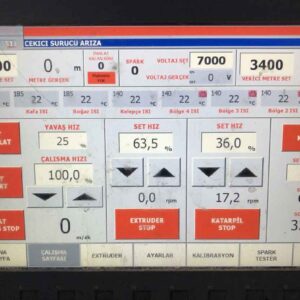
- HMI (Human-Machine Interface) operator panel applications
- SCADA monitoring and control systems
- Servo motor and frequency inverter applications
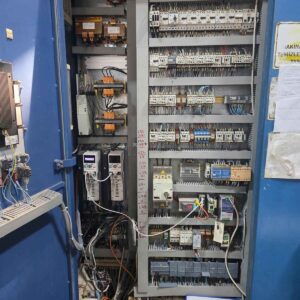
- Industrial electrical panels
- Machine overhauling and modernization
- Production line automation
Based in Denizli, DUOS Otomasyon develops engineering solutions for new automation projects and the modernization of existing systems across various industrial sectors.
Related page: Automation companies in Denizli and industrial automation solutions
2. Evaluate PLC and HMI Programming Competence
A PLC (Programmable Logic Controller) is a programmable control device used in industrial machinery to process input and output signals, thereby enabling the control of the machine.
An HMI (Human-Machine Interface) is a user interface that allows operators to monitor and modify machine parameters.
In a professional automation project, the PLC and HMI software must be compatible with one another. The following features are particularly important:
- Reliable management of the machine’s operating sequence
- Display of alarm and fault information
- Easy modification of production parameters
- Storage of recipes and operating settings
- Authorization and operator access levels
- Facilitation of maintenance and troubleshooting
A well-designed PLC and HMI system contributes to making operations more traceable and manageable.
3. Explore the Possibility of Modernizing Existing Machinery
Investing in new machinery is not always necessary for every automation requirement.
Machines with a sound mechanical structure but outdated control systems can be repurposed through modernization, provided the technical conditions are suitable.
Such projects may include:
- Replacing legacy PLC systems
- Upgrading operator panels
- Updating servo and drive systems
- Overhauling electrical control panels
- Replacing sensors and control equipment
- Developing new control software
Through machine retrofitting, businesses can update their control systems while retaining their existing equipment.
However, before deciding on modernization, factors such as mechanical condition, safety, spare parts availability, and investment costs must be carefully evaluated.
Technical information: Machine automation and modernization solutions
4. Consider SCADA and Production Monitoring Solutions
SCADA refers to systems used in industrial facilities to collect, visualize, and record process data, as well as to enable remote control under specific conditions. SCADA applications may include the following functions:
- Monitoring machine and process statuses
- Recording data on temperature, pressure, flow rate, and energy consumption
- Maintaining logs of alarms and events
- Generating production reports
- Analyzing operational history
- Providing authorized remote access
SCADA systems can offer operational visibility, particularly in settings such as textile dyehouses, water treatment plants, and production facilities where numerous machines operate in tandem.
5. Prioritize Industry-Specific Experience
Beyond their technical capabilities, the experience that automation firms possess regarding the specific sectors in which they operate is of great importance.
In the industrial landscape of Denizli, some areas with a significant need for automation include:
Textile automation: Dyeing, washing, chemical dosing, temperature control, and recipe management.
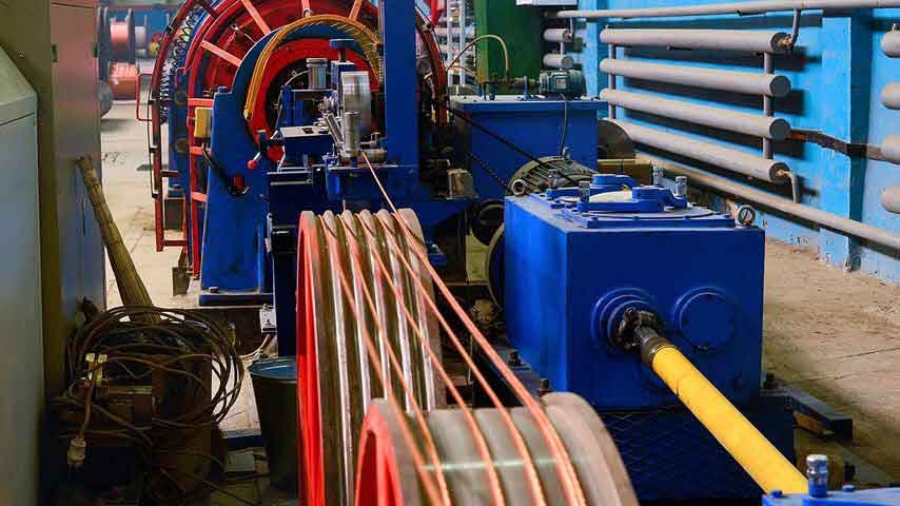
Cable production automation: Wire drawing, extrusion, twisting, coiling, and line synchronization.
Treatment plant automation: Pump control, tank level monitoring, filtration, reverse osmosis, and process monitoring.
Packaging automation: Filling, weighing, cutting, labeling, conveyor operations, and final packaging.
Iron and steel automation: Rolling mill control, drive systems, material handling, and production line synchronization.
Each sector entails unique sensors, control scenarios, and safety requirements. Therefore, an engineering approach tailored to the specific project must be adopted.
6. Understand the Commissioning and Technical Support Processes
It is a mistake to assume that a project is complete once the automation system has been installed.
A successful implementation requires careful planning for commissioning tests, operator training, technical documentation, and maintenance procedures.
Before engaging with an automation firm, it is useful to ask the following questions:
- What are the delivery terms for the PLC and HMI software?
- Will electrical schematics and technical documentation be provided?
- How will commissioning and acceptance testing be conducted?
- What is the procedure for technical support in the event of a malfunction?
- How will system updates and spare parts support be handled?
Clarifying these points during the contract phase helps to mitigate long-term operational risks.
7. Request Project-Specific Engineering and Proposals
Every factory and production line operates under unique conditions.
Therefore, decisions regarding automation projects should not be based solely on price.
A technical proposal should take the following factors into account:
- The current state of the machinery or facility
- Production capacity and process requirements
- The infrastructure for PLCs, HMIs, and drives
- Electrical control panels and field equipment
- The scope of software development
- Installation and commissioning terms
- Technical support and documentation
A proposal with a clearly defined scope allows for a more accurate comparison of investment costs and technical parameters.
Industrial Automation Solutions in Denizli: DUOS Otomasyon
Established in Denizli in 2018, DUOS Otomasyon provides services in the fields of industrial automation, machine automation, PLC and HMI applications, SCADA systems, and the modernization of existing machinery.
The company develops solutions for the control and monitoring of production processes across various industrial sectors, including textiles, cable manufacturing, water treatment, rolling mills, and more.
For investments in new production lines, automation upgrades for existing machinery, or process monitoring projects, it is essential to identify technical requirements in advance.
Businesses in Denizli seeking an automation partner can review the scope of services offered by DUOS Otomasyon and request a technical consultation or a project proposal.
Detailed information: DUOS Otomasyon – Industrial Automation Solutions in Denizli
Frequently Asked Questions
What services do automation companies in Denizli offer?
Industrial automation companies typically provide services such as PLC programming, HMI design, SCADA systems, electrical panel assembly, machine retrofitting, drive systems, and production line automation. Each company may have its own specific areas of expertise.
What is a PLC automation system?
A PLC (Programmable Logic Controller) automation system is a setup that evaluates input signals from a machine or industrial process and manages output equipment based on pre-programmed control logic.
Can older machines be adapted for automation?
Many machines can be modernized following a technical assessment. However, their mechanical condition, safety requirements, and economic feasibility must be evaluated.
What are the benefits of SCADA systems for factories?
SCADA systems provide functions such as centralized monitoring and recording of process data, alarm management, and operational analysis.
How can one obtain a quote for machine automation in Denizli?
Technical details of the existing machine, its operational scenario, the desired automation functions, and any available electrical schematics should be shared with an automation company. You can contact DUOS Otomasyon via duosotomasyon.com.